

AI-Powered Email Marketing in 2026: How Smart Personalization Can Increase Engagement, Leads & ROI
Email inboxes are more crowded than ever, making generic campaigns harder to notice and even harder to convert.
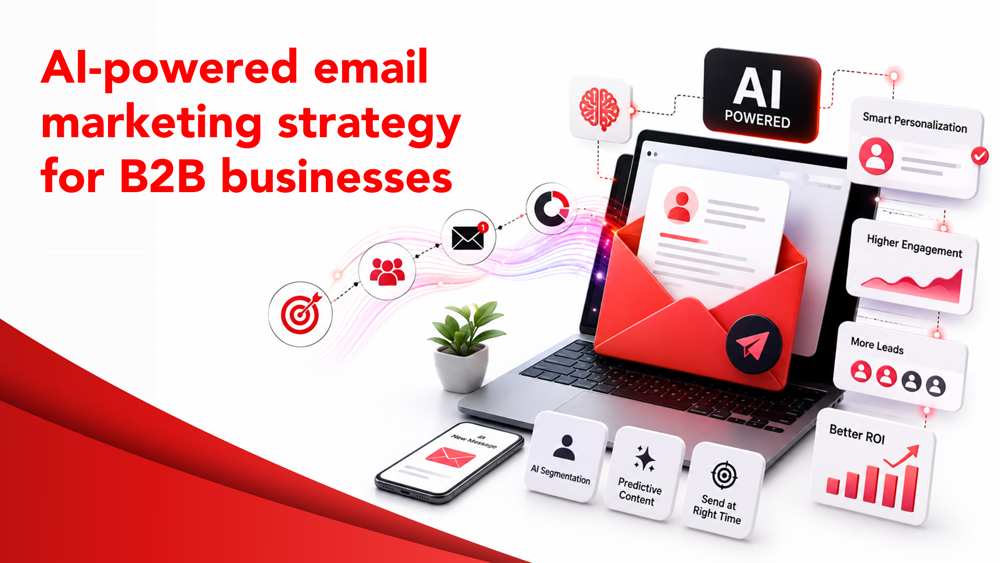
AI-powered email marketing is changing this by helping businesses personalize communication, understand customer behaviour, automate follow-ups, and deliver more relevant messages at the right time. In 2026, successful email marketing is moving beyond simply adding a recipient's first name. AI can use behavioural signals, audience data and engagement patterns to create more relevant customer journeys and improve marketing ROI.
For B2B businesses with longer sales cycles, smart email personalization can be especially valuable because it helps nurture prospects with content that matches their interests, industry, buying stage and intent.
Quick Answer
What Is AI-Powered Email Marketing?
AI-powered email marketing uses artificial intelligence, automation and customer data to improve different stages of an email campaign. Instead of sending the same message to an entire database, businesses can use AI to identify patterns and personalize communication at scale — assisting with audience segmentation, content recommendations, subject-line optimization, send-time prediction, lead scoring and automated follow-ups.
Recent 2026 marketing research shows that AI-driven or predictive personalization has become one of the most common approaches to email personalization, moving beyond basic name-based personalization.
Why Traditional Email Marketing Is No Longer Enough
Traditional “batch-and-blast” campaigns treat every subscriber the same. But a first-time website visitor, an existing customer, and a sales-ready prospect should not receive the same email.
B2B buyers expect relevant information that helps them make decisions. With multiple stakeholders and longer buying journeys, businesses need communication that adapts to the recipient.
This is where AI-powered email marketing can make a difference. A strategic approach from a ChalkWalk Marketing Agency can help businesses combine personalization, automation and content strategy to create more relevant customer journeys.
5 Ways AI Can Improve Email Marketing ROI
1. Smarter Audience Segmentation
AI can analyze customer and prospect data to identify meaningful audience groups based on behaviour, engagement, industry, interests and buying signals.
Instead of creating only broad segments such as “customers” and “prospects,” marketers can build more specific groups. For example:
- Prospects who downloaded a product brochure
- Customers who have not engaged recently
- Leads repeatedly visiting a service page
- Prospects interested in a specific product category
- High-intent leads ready for sales follow-up
More relevant segmentation means fewer irrelevant emails and better opportunities for conversion.
2. Personalization Beyond the First Name
Personalization is no longer limited to writing “Hi [Name].” AI can help personalize email content, product or service recommendations, case studies, offers, calls to action, follow-up sequences, and content based on industry or role.
For example, a manufacturing decision-maker may receive a case study about improving operational efficiency, while a marketing manager could receive content focused on lead generation. This makes the communication more useful instead of simply more personal.
3. Better Timing and Automated Follow-Ups
Sending a great email at the wrong time can still produce poor results. AI-powered systems can analyze engagement patterns and help determine when individual recipients are more likely to interact with emails.
Automated workflows can then trigger relevant messages based on actions such as clicking a link, downloading content or visiting a website — allowing businesses to build customer journeys instead of relying on one-time campaigns.
4. AI-Assisted Content and Subject Lines
AI can help marketers generate and test different subject lines, email variations and calls to action. However, the goal should not be to produce more emails simply because AI makes content creation faster.
The goal should be to create better and more relevant communication. Marketers should combine AI-generated suggestions with human expertise, brand knowledge and customer understanding before sending campaigns.
5. Predictive Lead Scoring
For B2B businesses, not every email subscriber is equally valuable. AI can help identify prospects showing stronger buying intent by analyzing engagement signals such as email interactions, website activity and content consumption.
Marketing teams can then prioritize high-intent leads for sales follow-up while continuing to nurture prospects who are still researching — helping marketing and sales teams focus their time where it has the greatest potential business impact.
How to Build an AI-Powered Email Marketing Strategy
AI works best when it is connected to a clear marketing strategy. Businesses should start by defining their audience, customer journey and desired outcome. A practical approach is:
Clean Your Database
Remove outdated, duplicate and invalid contacts.
Define Meaningful Segments
Group contacts according to industry, role, behaviour, customer stage and intent.
Create Relevant Content
Develop educational content, case studies, product information and offers for different audience needs.
Build Automated Journeys
Create workflows for welcome emails, lead nurturing, follow-ups, re-engagement and customer retention.
Introduce AI Gradually
Start with segmentation, personalization, recommendations or subject-line testing instead of automating everything at once.
Measure Business Outcomes
Track clicks, conversions, qualified leads, pipeline contribution and revenue rather than focusing only on open rates.
Research published in 2026 also highlights predictive personalization and AI segmentation as major contributors to AI-driven email business impact.
Which Email Marketing Metrics Should You Track?
AI does not automatically create ROI. Businesses need to measure whether campaigns are contributing to real business outcomes.
Important metrics include:
- Click-through rate
- Conversion rate
- Qualified leads generated
- Lead-to-opportunity rate
- Revenue attributed to email
- Customer retention
- Unsubscribe rate
- Cost per lead
- Email marketing ROI
For B2B businesses, qualified leads and pipeline contribution are often more meaningful than simply chasing higher open rates. Industry benchmarks continue to position email as a high-ROI B2B marketing channel, but the actual return depends heavily on list quality, segmentation, deliverability, personalization and measurement.
AI + Human Expertise: The Winning Combination
AI can analyze data and automate repetitive marketing tasks, but it should not replace strategic thinking.
Human marketers still need to understand:
What the Customer Actually Needs
Understanding real pain points and priorities beyond what the data alone can show.
What Makes the Brand Different
Positioning and messaging that reflect authentic brand identity and values.
Which Problems the Audience Faces
Context and empathy that shape genuinely useful, relevant content.
What Message Builds Trust
Tone, honesty and credibility that no algorithm can fully replicate.
When a Sales Conversation Is Appropriate
Judgment on timing and readiness that combines data signals with human experience.
The strongest strategy is therefore not AI versus human marketing. It is AI supporting human creativity, strategy and decision-making. For businesses looking to combine AI with a broader B2B growth strategy, working with an experienced top B2B growth marketer can help connect email marketing with SEO, content, paid marketing, social media and lead generation.
Conclusion
AI-powered email marketing is becoming an important part of modern B2B digital marketing. From intelligent segmentation and personalized content to automated nurturing and predictive lead scoring, AI can help businesses make their email campaigns more relevant and measurable.
But technology alone will not increase ROI. The real advantage comes from combining quality data, smart personalization, useful content, automation and continuous measurement.
For businesses looking to generate qualified leads and build stronger customer relationships, the future of email marketing is not about sending more emails. It is about sending the right message to the right person at the right stage of the buying journey.
At ChalkWalk Marketing Agency, we help businesses build digital marketing strategies that connect SEO, content, social media, paid marketing and email marketing to measurable business growth. Our approach focuses on generating meaningful engagement, qualified leads and long-term B2B growth.
Ready to turn your email campaigns into a stronger lead-generation channel? Get in touch with ChalkWalk Consulting at info@chalkwalkconsulting.com to discuss your digital marketing strategy.
Frequently Asked Questions
What is AI-powered email marketing?
AI-powered email marketing uses artificial intelligence, customer data and automation to personalize campaigns, segment audiences, optimize communication and improve marketing performance.
How does AI improve email marketing ROI?
AI can improve ROI by helping businesses target relevant audiences, personalize content, automate follow-ups and identify high-intent prospects.
Can AI personalize emails automatically?
Yes. Depending on the marketing platform and available data, AI can personalize content, recommendations, audience segments, timing and customer journeys.
Is AI email marketing useful for B2B companies?
Yes. It can be particularly useful for B2B businesses because it supports lead nurturing, segmentation, personalized communication and sales follow-up across longer buying cycles.
Will AI replace email marketers?
No. AI can automate repetitive tasks and analyze large amounts of data, but strategy, creativity, brand understanding and customer insight still require human expertise.
Leave a Comment
Your email address will not be published. Required fields are marked *