

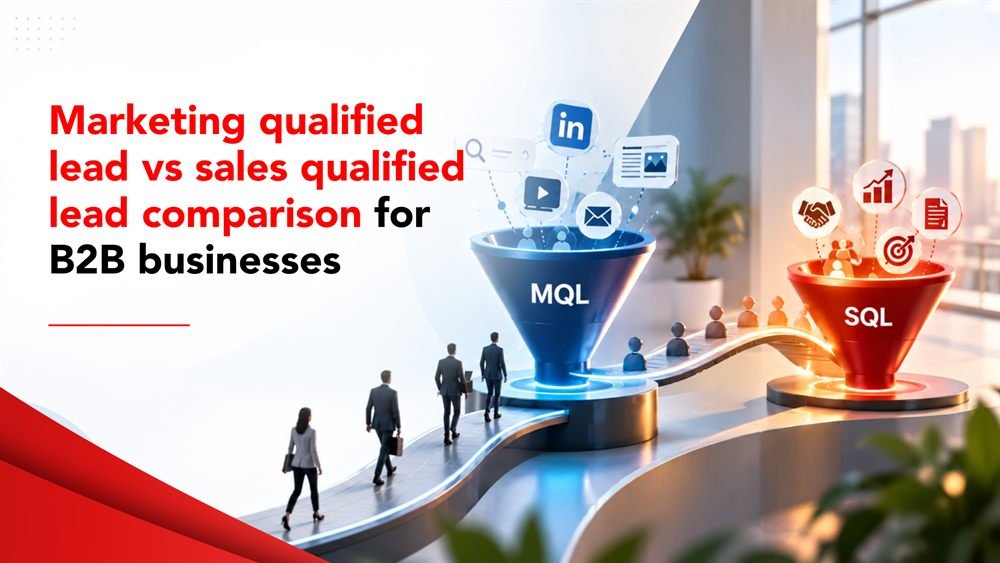
What Is the Difference Between a Marketing Qualified Lead and a Sales Qualified Lead?
A marketing qualified lead (MQL) is a prospect who has shown meaningful interest in a company's products or services through marketing activities but may not yet be ready for a sales conversation.
A sales qualified lead (SQL) has progressed further and meets the agreed criteria for direct sales engagement.
Understanding the difference helps B2B companies improve lead qualification, marketing-sales alignment and follow-up.
Quick Summary
MQL vs SQL: The Simple Difference
MQL = Interested and needs nurturing. SQL = Qualified and ready for sales engagement. An MQL may still be researching different solutions, while an SQL has usually demonstrated stronger intent and is ready for a more direct business conversation.
What Is a Marketing Qualified Lead?
A marketing qualified lead is a prospect who has demonstrated enough interest or engagement to receive focused marketing attention. An MQL may have:
- Downloaded a guide or brochure
- Attended a webinar or industry event
- Repeatedly visited important website pages
- Engaged with email campaigns
- Interacted with social media content
- Matched the company's target customer profile
However, engagement does not automatically mean the prospect is ready to buy.
When Does a Lead Become an MQL?
The exact criteria depend on the company. Marketing teams can define an MQL using factors such as company profile, industry, job role, website behaviour, content engagement and lead-scoring rules.
The goal is to identify prospects who deserve continued nurturing.
What Is a Sales Qualified Lead?
A sales qualified lead is a prospect who has moved beyond general interest and is considered ready for direct engagement with the sales team. An SQL may show stronger buying signals such as:
- Requesting a product demonstration
- Asking for pricing or a quotation
- Discussing a specific business requirement
- Requesting a consultation
- Confirming a purchase timeline
- Showing a clear need for the solution
What Makes an SQL Sales-Ready?
Sales teams generally look at factors such as need, fit, authority, budget and timing. The exact qualification criteria should be agreed between marketing and sales rather than assumed to be the same for every business.
Example of MQL vs SQL
Imagine a manufacturing company downloads a guide about improving production efficiency.
MQLThe person becomes an MQL because they have shown interest in the topic and fit the target audience.
SQLLater, the same person requests a product demonstration and asks about implementation timelines. This stronger buying intent may qualify the person as an SQL, depending on the company's criteria.
Why Is the MQL-to-SQL Handoff Important?
A clear handoff helps marketing and sales understand what happens when a lead moves from one stage to another.
Marketing can focus on generating and nurturing suitable prospects, while sales can spend more time on leads that meet agreed qualification criteria.
This also creates a feedback loop. Sales can tell marketing why leads were accepted, rejected or returned for further nurturing.
How Can Businesses Improve MQL to SQL Conversion?
Start by creating shared definitions. Marketing and sales should agree on:
- Ideal customer profile
- MQL qualification criteria
- SQL qualification criteria
- Buying signals
- Lead handoff process
- Follow-up expectations
- Lead feedback process
Use CRM and marketing data to monitor how leads move through the funnel. Regularly review the criteria using actual conversion and sales feedback rather than keeping the same rules indefinitely.
What Should You Measure?
Useful metrics can include:
- MQL volume
- MQL-to-SQL conversion
- SQL-to-opportunity conversion
- Lead response time
- Lead source
- Cost per qualified lead
- Revenue generated from qualified leads
Frequently Asked Questions
What is an MQL?
An MQL is a prospect who has shown sufficient interest or engagement to be considered qualified for further marketing attention.
What is an SQL?
An SQL is a prospect considered ready for direct sales engagement based on agreed qualification criteria.
Which comes first, MQL or SQL?
In a common B2B funnel, the MQL stage comes before SQL as a prospect progresses from interest toward sales readiness.
Can an MQL become an SQL?
Yes. An MQL can become an SQL when it demonstrates stronger buying intent and meets the company's sales qualification criteria.
Why is MQL vs SQL important?
It helps marketing and sales agree on lead quality, improve handoffs and focus resources on prospects at the appropriate stage.
Conclusion
Understanding the difference between a marketing qualified lead and a sales qualified lead helps B2B companies create a more organised lead management process.
Instead of treating every enquiry the same, businesses can nurture interested prospects and prioritise leads that demonstrate stronger buying intent.
Improve Your B2B Lead Qualification Process
For B2B lead generation, digital marketing and sales support, connect with ChalkWalk Consulting.
Leave a Comment
Your email address will not be published. Required fields are marked *