

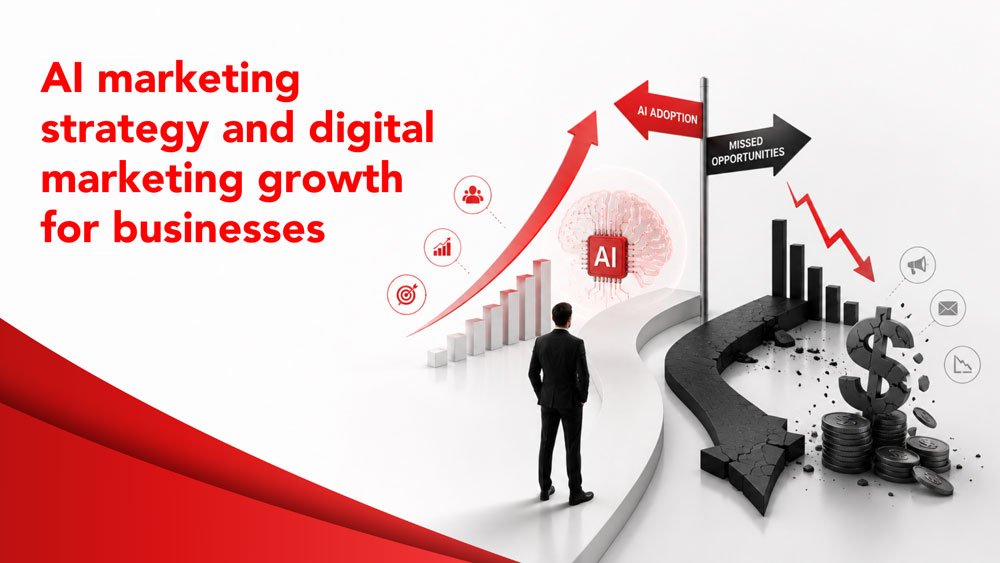
The Hidden Cost of Not Adopting AI in Marketing Strategy
The AI marketing strategy landscape is changing fast. Businesses that once viewed AI as an optional technology are now using it to understand customers, personalize campaigns, automate repetitive tasks and make faster marketing decisions.
The real question in 2026 is no longer whether businesses should use AI, but what they may lose by waiting too long.
For B2B companies especially, avoiding AI can mean slower lead generation, inefficient campaigns, missed customer insights and higher marketing costs. While competitors are using AI to work smarter, businesses that continue relying entirely on manual processes may slowly fall behind.
Quick Answer
What Is an AI Marketing Strategy?
An AI marketing strategy uses artificial intelligence to improve activities such as customer analysis, personalization, automation, content creation, lead scoring and campaign optimization — helping marketing teams work faster while focusing more of their time on strategy and creativity.
Why AI Marketing Strategy Matters in 2026
Marketing has become more data-driven, competitive and customer-focused. Businesses collect huge amounts of information from websites, social media, email campaigns, paid advertising and CRM systems.
The challenge is turning that information into useful action.
An effective AI marketing strategy can help businesses analyze patterns, identify opportunities and automate repetitive tasks while allowing marketing teams to focus more on strategy and creativity.
The Hidden Costs of Ignoring AI
Not adopting AI does not mean your marketing stops working. It means you may be spending more time, money and resources achieving results that could be achieved more efficiently. Here are some of the biggest hidden costs.
1. Slower Marketing Decisions
Without AI-assisted analytics, marketers often spend significant time collecting, organizing and interpreting data manually.
AI can process large datasets quickly and identify patterns that may otherwise take hours or even days to discover. Faster insights can lead to faster decisions about campaigns, audiences, content and budgets.
2. Higher Cost of Manual Work
Marketing teams spend time on repetitive activities such as reporting, audience segmentation, content variations, email scheduling and campaign analysis. These tasks may appear small individually, but together they can consume valuable working hours.
AI automation can reduce repetitive workload and allow teams to spend more time on activities that require human thinking, creativity and business understanding.
3. Missed Personalization Opportunities
Customers expect relevant communication. Sending identical emails, advertisements or content to everyone can reduce engagement. AI can help marketers understand customer behaviour and create more relevant segments.
For example, a potential buyer researching a service can receive educational content, while a high-intent prospect can receive a stronger sales-focused message. That difference can directly influence conversions.
What Happens When Competitors Adopt AI First?
AI Can Create a Competitive Gap
Imagine two businesses targeting the same market. One uses AI to analyze campaign performance, personalize communication, identify high-intent leads and automate follow-ups. The other manages these activities manually.
Both may have talented marketing teams, but the first business can potentially test faster, respond faster and scale campaigns more efficiently. Over time, that difference can become a competitive advantage.
The Real Risk Is Falling Behind Quietly
The biggest danger is that businesses may not immediately notice the impact. There may not be one dramatic moment when a company “loses” because it did not adopt AI. Instead, the gap can appear gradually through:
- Higher customer acquisition costs
- Slower lead response
- Lower campaign efficiency
- Missed customer insights
- Less personalized communication
- More time spent on manual reporting
- Slower content production and testing
AI Does Not Mean Replacing Your Marketing Team
One common misconception is that adopting AI means replacing marketers. That is not the right approach.
The stronger model is AI + human expertise. AI can handle data analysis, automation and repetitive processes. Humans bring creativity, strategic thinking, brand understanding and customer empathy.
The Goal Is Smarter Marketing, Not Less Human Marketing
Businesses should use AI to make their teams more productive, not less important. The right AI marketing strategy combines technology with human decision-making to create campaigns that are faster, more relevant and more measurable.
How Businesses Can Start Using AI
Companies do not need to transform their entire marketing operation overnight. Start with areas where AI can create immediate value. The key is to start with a specific business problem rather than adopting AI simply because it is trending.
Customer Segmentation
Identify audiences based on behaviour and intent.
Content Assistance
Generate ideas, variations and content outlines faster.
Email Automation
Build personalized lead-nurturing journeys.
Campaign Analysis
Identify performance patterns and optimization opportunities.
Lead Scoring
Prioritize prospects showing stronger buying signals.
Reporting
Reduce manual work involved in collecting marketing data.
How to Measure the ROI of AI Marketing
AI adoption should ultimately connect to business outcomes. Track metrics such as:
- Cost per lead
- Qualified leads
- Conversion rate
- Customer acquisition cost
- Campaign ROI
- Lead response time
- Marketing productivity
- Revenue generated from campaigns
If AI reduces manual work while improving lead quality and campaign performance, its value becomes much easier to demonstrate.
Conclusion
The hidden cost of ignoring AI is not simply missing a new technology. It is the potential loss of speed, efficiency, personalization and competitive advantage.
Businesses that start using AI thoughtfully today can give their marketing teams more time to focus on what technology cannot replace: strategy, creativity and meaningful customer relationships.
The future of marketing is not AI versus humans. It is humans using AI better.
Want to make your marketing more efficient and ROI-focused? Explore digital marketing solutions with ChalkWalk Consulting, or get in touch at info@chalkwalkconsulting.com.
Frequently Asked Questions
What is an AI marketing strategy?
An AI marketing strategy uses artificial intelligence to improve activities such as customer analysis, personalization, automation, content creation, lead scoring and campaign optimization.
What is the biggest cost of not using AI in marketing?
The biggest cost can be lost efficiency. Businesses may spend more time on manual tasks, miss customer insights and struggle to personalize marketing at scale.
Can small businesses use AI in marketing?
Yes. Small businesses can start with affordable AI tools for content assistance, email automation, customer segmentation, analytics and lead management.
Will AI replace digital marketers?
AI is more likely to change marketing roles than completely replace marketers. Human creativity, strategy, communication and decision-making remain essential.
How quickly should a business adopt AI?
Businesses should start strategically rather than rushing. Identify repetitive or data-heavy marketing activities first, test AI there and measure the results.
Leave a Comment
Your email address will not be published. Required fields are marked *